Lindsey Gallagher (they/them) is a non-binary nonfiction writer from Shelter Island, New York. They are currently pursuing their MFA at Northern Arizona University. They serve as the Editor-in-Chief of Thin Air Magazine and teach English Composition. Their work can be found in The Oval and The Palhouse Review. Outside of writing, they enjoy running and outdoor adventures of many sorts.
Coming to a close!
Welcome back! This is the final post in the One Bite at a Time series! I’ll keep this short and sweet, just to impart one last bit of wisdom for you as you begin your plant-based journey!
Final words of advice!
We’ve covered a great deal in this blog: the basics of animal agriculture, its impact on the environment, questions to consider before you begin your plant-based diet, staple plant-based foods, an interview with a seasoned vegan, and a whole lot more! The amount of information is overwhelming, and this blog is certainly not an exhaustive resource or guide for going plant-based. If I were to include everything, you would be endlessly reading! And, despite the value of advice and recommendations, the real learning comes when you jump in and begin to experience life as a plant-based eater. You will grow so much as you face and overcome the challenges (and enjoy the delights) of this life change. All this is to say, at a certain point you’ve got to just start and embrace each step of the journey!
I want to remind you one more time that no one plant-based diet is objectively the “best.” The “best” plant-based diet is the one that works for you, whether that’s having three plant-based meals a week or a full-on vegan diet. It is so important to recognize your life experiences and circumstances and how to adapt your diet to fit your life so you can stick to it for the long term. Keep this in mind as you make the transition to plant-based eating, too. Make the transition work for you—there’s no need to stop eating all animal products overnight if you know that will be hard for you. Take it in small steps so you can adjust to the diet incrementally and ultimately make it sustainable for yourself!
Plant-based eaters: eating out is not off limits! Embrace social eating even as a plant-based eater! Pictured is a vegan Pad Thai from the wonderful Zoo Thai in Missoula, Montana.
No matter what kind of plant-based eater you are, flexibility remains crucial. Remember that straying from your diet is okay! Sometimes you have to deal with less than optimal situations and there’s no reason to get down on yourself or worry if you have to make changes. Flexibility also goes hand in hand with being creative in how you prepare for and handle experiences involving food, how you cook, and how you structure your eating habits.
Through all this, be patient with yourself! Listen to yourself throughout every part of your journey and make sure each thing you do is for you and not because of what others have told you or expect of you.
Celebrate plant-based living! Here is an intensely decorated vegan cake my sister and I made some time ago for a special occasion!
Finally, you are not alone in this exciting journey! There are countless resources out there (many of which I’ve included in this blog) to take advantage of. Educate yourself on specific topics of interest concerning plant-based eating, try new recipes, and build community with other plant-based eaters!
Thank you so much for following along the past nine weeks! I sincerely hope some of my advice resonated with you and you’ve been able to apply it to your own life. If you ever have any questions regarding a plant-based lifestyle, I’m happy to answer! You can reach me at lindseymgallagher19@gmail.com.
I wish you all the best in your plant-based journeys! No matter where you are, remember to take it one bite at a time!
We’ll end with something sweet—apple crisp! This is one of my family’s favorites. Growing up, we would often make it after a fall apple-picking haul.
The recipe itself is rather simple, though coring and slicing the apples will take some effort and time. All you need to make this delicious treat is:
1 cup brown sugar
¾ cup flour
½ cup vegan butter
1 teaspoon cinnamon
½ cup oats
Apples! You’ll need enough to cover a 9×13 inch pan about 2 inches thick, which is roughly 8-12 apples. You can pick the variety of apple but Granny Smith, Honeycrisp, and Golden Delicious are some of the best for baking.
To make the crisp:
Preheat the oven to 350 °F.
Core and slice the apples. You can cut the apples into chunks, you can slice them into rounds, or into the everyday slice.
Place the apples on the bottom of a greased pan so they cover the entire pan and are roughly 2 inches thick.
Add all other ingredients to a bowl and mix until butter is well incorporated.
Bake at 350 °F for 45 mins. Turn halfway through. At 45 mins, check how it’s doing—the crisp may need more time depending on your desired crunchiness.
Enjoy! This pairs wonderfully with vanilla ice cream!
Lindsey Gallagher (they/them) is a non-binary nonfiction writer from Shelter Island, New York. They are currently pursuing their MFA at Northern Arizona University. They serve as the Editor-in-Chief of Thin Air Magazine and teach English Composition. Their work can be found in The Oval and The Palhouse Review. Outside of writing, they enjoy running and outdoor adventures of many sorts.
Interviewing a Vegan!
Emma hanging out with some sunflowers while visiting me in Missoula, Montana.
Welcome back! This week, I interviewed my sister Emma, who has been vegan as long as I have! Emma (she/her) is currently a student, entering her senior year at George Washington University. She is majoring in environmental science, along with political science and geographic information systems minors. She is an exceptionally involved member of her community, and fighting for climate justice is one of the causes most important to her. In our interview, we talked about her journey to veganism, how she has managed challenges the diet has presented, some of her favorite vegan foods, her experience being vegan abroad, and much more! Let’s hear what Emma has to say!
When was the first time you learned about vegetarianism and veganism? What was your initial opinion of it?
I don’t remember exactly when I first learned what it was, but I do remember the first time I really considered it was something that a lot of people actually did. The summer after 10th grade, I went to a summer camp where there was a significant group of vegetarians and vegans. It was the first time I really saw people encouraging and being respectful of the choice in a group setting. In fact, it was so encouraged at the camp that some people even decided to adopt a vegetarian or vegan diet just for the duration of the camp. I think prior to that, I had only experienced vegetarians and vegans being made fun of. I think like most people my initial opinion was probably judgmental, an “I could never do that” attitude. I remember laughing along to jokes at the expense of vegetarians and vegans without really knowing what it was like or why people did it.
One of Emma and I’s first vegetarian creations, a grilled tofu and zucchini sandwich.
Why did you first go vegetarian? Why did you decide to take it further and go vegan?
Around the time I went to this camp, I was simultaneously becoming more aware of the climate crisis and the impact of my individual behavior. At this point, it had become clear to me that I wanted to study environmental issues and ultimately pursue a career that would allow me to turn my love for the environment into something good. I remember reading articles and watching documentaries about the environmental, health, and socioeconomic impacts of plant-based diets. A few days after I had returned from camp, I distinctly remember sitting in the living room with my mom and Lindsey and saying that I had been thinking about going vegetarian. As it turns out, Lindsey was too, and we decided to embark on the journey together. It was great to have a support system from the start. I remember making fun vegetarian meals together that summer. It was only a few months before Lindsey and I made the transition from vegetarian to vegan. I think once I realized how much I enjoyed being vegetarian, and that it actually wasn’t that hard, I saw the jump to vegan as an easy feat.
Michael Pollan’s The Omnivore’s Dilemma is a read Emma and I highly recommend! Source
Has your reason(s) (your why) for being on a vegan diet changed over time?
Initially, my decision was driven by a desire to reduce my environmental impact. But when you are doing something and you love it, it is easy to realize other positives. As a runner, I knew how important health was for performance. I remember reading more articles and watching more documentaries about the negative health impacts of too many animal products. During this time, a group of people on our team also started experimenting with vegetarian and vegan diets. As time went on, I learned more about the practice of factory farming in the US and I was appalled. I read The Omnivore’s Dilemma by Micheal Pollen, and it really opened my eyes to how detached from our food system we are. I think that it is possible to ethically produce and consume animal products, but I believe most of the products in our stores are not derived from ethically sourced places. It would be a stretch to say I am totally tuned into where every single ingredient in every single thing I eat comes from, but I certainly feel more aware than I did before. So I would say my initial reason still stands, but other reasons for doing so have compounded and reassured me of my decision.
How was the initial transition to vegetarianism and then veganism? Was it easier or harder than you expected? What things were challenging? What things were easier?
Honestly, I don’t really remember struggling too much. Sure I faced some annoyances and challenges, but I was loving my decision. It is totally worth it. At home, it was easy because our family was supportive. I was motivated and excited about my decision, so any cravings for animal products were far outweighed by my larger goal. Plus, it was fun to find so many alternatives I had no idea existed. I often think about how lucky I am to live in a time when vegetarians and vegans have so many more options aside from the staple fruits, veggies, beans, nuts, grains, etc. (but many places still have a long way to go!) Certainly, the most frustrating part was attending events outside my home. Although places usually scraped together something to accommodate me, they were not nutritionally adequate or always pleasing to eat. Most often, the vegan option was a salad or some grilled vegetables. Don’t get me wrong, I love both, but after a while, it gets old when that is the only option when you’re out to eat.
The other aspect was pushback from people who didn’t understand my decision and were judgemental. I remember getting really mad sometimes and thinking, since when do people care so much about what I am putting into my body? Suddenly everyone is thoroughly and deeply concerned about my protein intake! I remember snapping a few times at my friends or family members because I was so annoyed. Since then, I have come to peace with the fact that no matter what you do, people are always going to question or judge you, so you might as well get on doing what makes you happy and what is best for yourself. Now when people share their concerns about my “protein intake,” I just move along. Keeping track of your nutrition is essential, no matter what diet you choose, but I find that people often speak without knowing all of the facts (I know I still have a lot to learn). I think there are a lot of people who consider animal products the best and only source of protein when that is so far from the truth. Many plant products are just as rich, if not richer than their animal-based counterparts, in protein (which you have probably already read about in this blog).
Emma and I a few years ago enjoying a meal with family!
What was the biggest surprise when you went vegan?
I think the biggest surprise when I went vegan was really becoming more aware of what I was consuming. I suppose most people naturally become more conscious as they get older, but I think being vegan amplified that for me. It made me more aware of the nutritional content of food, where my food was coming from, how to be creative with limited ingredients, and many other things. I somehow feel more respectful of my food now. I was also surprised that there are so many vegan alternatives!!
Emma and I enjoying some vegan food in Washington D.C.
What are some of your favorite vegan foods?
I am always obsessed with Oatly chocolate oat milk. On holidays at home, I usually make a vegan frittata with JUST Egg that turns out great. MorningStar Chik’n Nuggets and SIMULATE CHICKEN NUGGS (dino shaped) are also delicious. Miyoko’s classic chive cheese is a favorite of mine. Ben and Jerry’s has an assortment of vegan flavors but vegan Phish Food is my personal favorite! I go through phases where I am obsessed with Hippeas and White Cheddar Skinny Pop. Many of my favorite snacks growing up, like Oreos, Sugar Wafers, Tofutti Cuties, pretzels, and chips and salsa were already vegan! I love tofu because it is so versatile—you just need to know how to cook it properly (luckily it is actually quite simple). As much as I love all the vegan alternatives, they do tend to be more expensive and processed, so I enjoy them in moderation. On a day-to-day basis, I rely on oatmeal, rice, pasta, bread, beans, nuts, other grains, and lots and lots of fruits and vegetables. Burritos are one of my favorite things to eat; I love them for any meal (and they are so easily made vegan). Last summer, one of our close family friends found the most amazing recipe for a vegan lemon cake from Nora Cooks. It is one of the best cakes I have ever had. At home, we use Purple Carrot, and some of my favorite meals are General Tso’s tofu, lemon pepper tofu, black pepper tofu (there’s a theme here haha) and buffalo cauliflower quesadillas.
How do you manage people who aren’t welcoming to veganism?
I have come to terms with the fact that there are many people who will be judgmental of my choice. Generally, if someone makes a comment, I try my best to share my perspective and experience in a respectful manner. Some people are receptive and engage in a good conversation, but there are others who remain close-minded. I have learned some people just make comments or ask questions without actually being willing to consider the legitimacy of my response. They really just want to get a rise out of me. In these cases, after I have tried and failed to engage with them, I have learned to just hold my tongue and move along. I understand that there are a lot of misconceptions about plant-based eating out there, like our diets are lacking in protein, and some people just don’t want to try to understand when you go to correct them. But many people are willing to listen. In the beginning, I remember even some of my close friends would make snide comments and I would get mad at them and make comments back. Now, these friends are supportive and have even considered it for themselves. I always try to remember that it is easy for us as humans to attack things that are unfamiliar to us.
Enjoying a delicious vegan brunch at The Catalyst Cafe in Missoula!
It has been almost four years since I started my plant-based journey, and I have learned a lot. One of the things I have learned is that vegetarians and vegans can be just as rude and critical of others as non-vegetarians or non-vegans. Early on, I remember feeling a sense of superiority because of my decision, but I have come to strongly disapprove of that holier-than-thou attitude in myself and in others. In thinking my diet was “better” than someone else’s, I was being just as judgmental as those who gave me pushback and made me feel frustrated. Even more than that, there is absolutely no “right” diet for anyone. Every person has their own health, cultural, religious, financial, and emotional considerations in determining their diet. Deciding what food to put in your body is a very personal choice, and no one, myself included, has the right to make that decision for another.
I believe I will be a champion of a plant-based diet for the rest of my life, but I am very intentional about respecting others’ choices. Of course, I am willing to have conversations with and support people wanting to make the change, but I try my best not to make anyone feel shameful or guilty over such a personal decision. I guess what I am trying to say is that because I have experienced and perceived many benefits, I hope anyone willing and capable will try it out, but I never think forcing someone into something, especially something so personal, is a good idea. I have seen campaigns try to use guilt and shame to get people to go vegetarian or vegan. Sometimes it may work, but most often it has the reverse effect and drives people away. If the goal is to encourage plant-based eating, it should be done in a positive, intelligent, and respectful way. Sometimes if someone makes a rude comment to me, it is still hard to hold my tongue, but I am getting better at it.
How do you manage social situations (or eating out) when there are limited (or no) vegan options?
I always prepare myself. I check out the menu beforehand and strategize about what I am or am not willing to be flexible about. Often a restaurant will not have a completely vegetarian or vegan option, so I will plan two or three options to modify. For example, if there is pasta with meat and a sandwich with cheese I will ask the server if the pasta can be served without the meat or if the cheese can be removed from the sandwich. More often than not, they are happy to make the change. Being vegan definitely requires more attention to detail. Sometimes it is stressful, not because I am questioning my desire to be vegan, but because I don’t want to be a hassle or make others change their plans. But I also know I deserve to eat food that I want to put in my body. And I have learned that my best friends are people that care to plan ahead and make sure there are options for me so I don’t have to compromise myself. If I am in a situation where there truly is no vegan option, I will just go ahead and eat something with a little milk, butter, or cheese because I know that I need to fuel my body. Even still, sometimes I leave a place a little hungry. In cases where I know this will be true, I just eat some more of my own food before I go out or when I return after an event. It is all about planning so you don’t have to compromise your health, well-being, or adherence to your diet.
Vegan treats at a vegan festival in Washington D.C. that I attended!
What have you found is the greatest challenge to being vegan?
I think I answer this in previous questions, but it’s unaccommodating service. That is the greatest challenge for me, but I know how to navigate that after a few years of practice. Rude and judgmental comments are annoying, but I don’t let them get to me like I did at the start of my plant-based journey.
Emma enjoying a White Zombie donut from Veera Donuts, an all-vegan donut shop in Missoula!
What’s the best vegan food you’ve ever had at a restaurant? (Both an entree and a dessert)
Oh god, it is really hard to just choose one. I will just brainstorm some favorites off the top of my head and see if I can pick out just one. Favorite desserts include vegan key lime pie from Busboys and Poets in Washington D.C., chocolate ice cream sundae from Flax and Kale in Barcelona, vegan red velvet and cinnamon apple cupcakes from Georgetown Cupcake in D.C., donuts from Donut Run in D.C., donuts from Veera Donuts in Missoula, cupcakes from Sticky Fingers in D.C., Oreo cupcake from Baked and Wired in D.C. Favorite meals include absolutely anything from Aunts et Uncles in Brooklyn, vegan chipotle super sandwich from Brunch and Cake in Barcelona, vegan caesar salad from Flax and Kale in Barcelona, chicken wings from Sticky Fingers. At Essex market in Manhattan, there is a vegan cheese shop called Riverdel that is amazing. If I have to pick just one, I think it would be the french toast at Aunts et Uncles and a Boston cream donut from Donut Run.
Emma’s favorite spot in Arc Iris, looking down from the balcony. Photo by Emma
What is your favorite vegan memory?
The first thing that comes to mind was actually when I was studying abroad. Right across the street from my homestay in Barcelona was a little restaurant called Arc Iris. They always had a line out the door. For 14 euros, you got bread, a three-course meal, and a dessert. Every day the menu changed, and the restaurant displayed three options for each of the three courses outside on a chalkboard. The service was incredibly quick, the food was fantastic, and it was all vegetarian. I went a few times simply because I so enjoyed sitting up in the corner of the restaurant alone with my thoughts and my delicious plant-based food admiring the thriving eatery. The energy always felt so positive there. It was a simple thing, but I just remember being so happy in there.
How did you manage your diet while studying abroad? Did you decide beforehand that you would be flexible with your vegan diet? How did it feel to be off the vegan diet? How does it feel now that you are mostly back to being strictly vegan?
A gnocchi dish from Palmenhaus in Vienna. Photo by Emma
Quite honestly, it was often easier to be vegan while I was studying abroad than it was to be vegan in the US. Studying abroad has been something I have looked forward to for as long as I can remember, and I knew I was going to make the most out of every second. Before I went abroad, I knew I was not going to be strict. I wanted to experience parts of the culture and I knew that traveling around almost every weekend to new places would require some flexibility. At the end of the day, I needed to make sure I was eating enough to fuel my body!
Tofu omelette and side of potatoes from Equilivrium Cafe in Barcelona. Photo by Emma
I decided to stay with a host family for my abroad experience. At first, I was worried about my diet, but then I was assigned a host mother and roommate who both also ate mostly vegan. My host mother was an excellent cook, and it was fantastic to enjoy vegan versions of traditional Spanish food such as tortillas. I was very fortunate. I studied in Barcelona, and I was absolutely blown away by the number of vegetarian/vegan options at restaurants and grocery stores— even more so by the number of plant-based only restaurants. Within a few minutes walk of my apartment, there were three, and the food at each one was amazing! Most of the cities I traveled to in Western and Eastern Europe had great plant-based options. I expect my experience would have been different had I traveled to more rural places, but overall it was wonderful to see how celebrated and respected plant-based eating was.
Escalivada (a traditional Catalán dish) pumpkin and coconut soup and sangria from Casa Lolea in Barcelona. Photo by Emma
There were a few challenging times, and I strayed from my diet due to need or desire to. One time, my friends and I went on a day trip to Andorra la Vella, the capital of a super small country called Andorra between France and Spain. We arrived early on a Sunday morning, and it was a very cold January day. It was one of our first trips outside Barcelona. We got off the bus and had absolutely no idea where we were going or what to do. We wandered for a while until we finally found a small breakfast place that was open (most things were closed because it was Sunday). The workers spoke French, Spanish, and Catalan, but no English. Between us, we knew a decent amount of Spanish and very little French. Not all of the menu items were available, and most of them were sandwiches with meat. I ended up having to order a sandwich with an egg. I ate as much of it as I could because I knew it was going to be a long day. I got a few bites in and eventually was too grossed out to eat anymore, so I just finished the bread. That was probably the hardest experience I had—yet I survived!
Vegan Supersandwich and carrot cake cupcake (not plant-based) from Brunch and Cake in Barcelona. Photo by Emma
Many other times, I willingly ate cheese or desserts with milk and eggs simply because I felt like it. I have no regrets! I did not eat any meat because at this point I truly have no desire to and don’t think I ever will, but this of course could change at some point in my life. The longer I have been vegan the more flexible I have become, and being abroad was a great reminder of how important it is to consider and celebrate the emotional and cultural significance of food alongside our moral beliefs about it. In the two months since returning from Spain, I have had an occasional slice of cheese, some ice cream, and Goldfish. Goldfish are definitely the snack I missed most being vegan. And they make me happy! Since they make me so happy, I have decided I will break from my vegan diet when I have a craving because it is not the end of the world if I have a few handfuls now and then. It felt good to break from my vegan diet while abroad, and it feels good to mostly be back to being vegan now that I am home.
Açaí bowl and pan con tomate from Bristol in Barcelona. Photo by Emma
This experience has reminded me of how dynamic life is and how crucial it is to check in with yourself. During those months, it was important to me to break from my diet, and now it is important to me to mostly go back to being vegan. I will add that although I had a relatively easy and positive plant-based experience while traveling abroad, this should not always be expected. It is best to err on the side of caution and do as much research as you can before you travel. Make any necessary accommodations, and look up grocery stores, markets, and restaurants that will have things you can eat. It is sometimes most convenient to shop and cook for yourself. But always be aware that the potential for you to stray from your diet is there. In some places, it is expected that you eat what is put in front of you. If you are traveling to one of these places and are uncomfortable with this, you might want to reconsider your plans. My personal opinion, and something I live by when I am traveling, is that I do not want to miss out on an opportunity just so I can stick to my diet. My diet is very important to me, but there are lots of other things that are just as or more important. Every person should consider their own priorities and what will make them the happiest.
Vegan carrot cake cupcake from Melbourne Street Cafe in Ibiza. The server told Emma that they use pineapple to replace eggs—how creative! Photo by Emma
What advice do you have for people who are looking to go plant-based (or for new plant-based eaters)?
The greatest advice I can give to anyone considering the move towards a plant-based diet is to remain open-minded and flexible. Don’t be too hard on yourself or others! You are not tied to anything, and you can always change your mind if something doesn’t feel right for you for any number of reasons. Be flexible, but also know your boundaries. You should know what you are or are not willing to break your diet for and in what circumstances. Of course, these boundaries can always change. For me, I know that eating meat is something I will not do, but I am okay with consuming some milk or cheese if that is the only option. Be as flexible as you are comfortable with and be an advocate for yourself. Sometimes people really don’t understand what you mean when you say vegan, so you might have to clarify what you can’t eat. Usually, restaurants are accommodating enough, but do be prepared to encounter some pushback now and then. It is going to happen! More advice: surround yourself with other plant-based eaters, or at least with people who are going to support your decision. It is a much more positive experience if you are not doing it alone. If there is no one immediately around you, seek out that community. It is there somewhere! (It might even be online ;).
For both Emma and I, having support from one another as we began our plant-based journeys was crucial! That support remains crucial to this day!
Anything else you want to add?
I ended up writing my high school senior thesis about the implications of going vegan. While I am proud of the work I produced, looking back, I now have a much broader perspective. When I produced that project, I was very much focused on the individual environmental impacts of going vegan. I have mentioned that it is a very personal choice, and I do believe we should each be doing what we can to reduce our environmental impact. I believe even one person making a change can make a difference, but at the same time, I want to emphasize the necessity of situating our individual choices in the context of a larger system. It is very apparent there are several major forces driving climate change, and I wholeheartedly believe that fighting these forces is more impactful than my decision not to eat steak for dinner today. So, in terms of the environment, do as much as you can without compromising your needs, but do not take on the moral burden of forces out of your control!
Conclusion
I’m so glad I was able to share Emma’s perspective and experiences on plant-based eating with you! Emma had so many important things to say! I sincerely hope you enjoyed hearing from her!
Next week, August 11th, I will be taking a break from One Bite at a Time. I’ll be back on August 18th for one more post to conclude the series!
Thanks for reading!
Lindsey 🙂
Recipe of the week: Homemade Red Sauce (my mom’s recipe)!
Red sauce is a staple for most people, considering its versatility. Growing up, my mom made this delicious meatless red sauce that my family always adored. For this recipe, all you will need is one large can (28oz) of crushed tomatoes, 1-2 cloves of minced garlic, olive oil, garlic salt, and sugar. My mom doesn’t have exact proportions for putting this together, it’s mostly to taste, so do your best! To prepare:
Put minced garlic in the middle of a big frying pan and drizzle with a fair bit of olive oil to surround it
Pour on garlic salt
Saute for 1-2 mins. Do not let garlic brown up!
Turn off stove
Add crushed tomato. Turn the heat back on low and stir a lot
Add 1-2 tablespoons more of olive oil
Add up to ⅛ cup sugar (to taste)
Mix and taste adding more garlic salt and sugar as needed
Keep mixture on heat for about 10 mins, stirring a lot
This sauce works great with pasta, for chicken or eggplant parm, for pasta bakes, for dipping, and really anything you can think of! Enjoy!
Some homemade eggplant parm and broccoli with my mom’s red sauce!
Lindsey Gallagher (they/them) is a non-binary nonfiction writer from Shelter Island, New York. They are currently pursuing their MFA at Northern Arizona University. They serve as the Editor-in-Chief of Thin Air Magazine and teach English Composition. Their work can be found in The Oval and The Palhouse Review. Outside of writing, they enjoy running and outdoor adventures of many sorts.
Taste Tests!
Welcome back! This week I’m very excited to take you with me for some taste tests of assorted plant-based products. I put some of my favorite products head-to-head with other brands, and I also tried some new items. It was lots of fun!
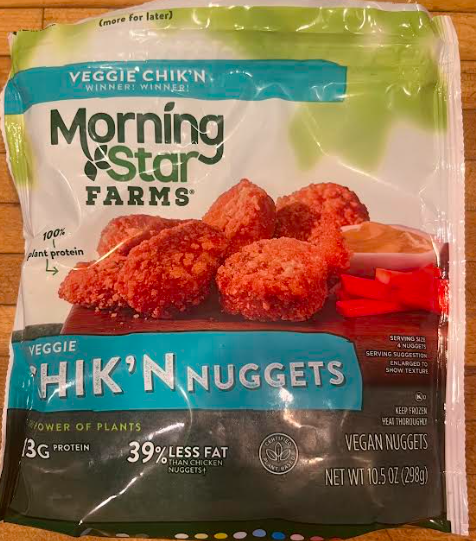
Clockwise from the top: Gardein, MorningStar Farms, and Impossible Foods nuggets.
We assessed seven different criteria to determine the all-around winner. These included:
Flavor of the “meat” – the seasoning of the inner meat and an answer to the basic question: does this taste good, or does it taste like chemicals?
Flavor of the breading – the seasoning in the breading and if it had that rich saltiness we so crave
Texture of the “meat” – how moist it felt and its composure (was it stringy, firm, chewy, tender?)
Texture of the breading – how crunchy and crispy it was
How chicken-like – how well the nugget mimicked a nugget made of real chicken meat, which is a sort of combination of the texture and the flavor of the “meat”
Protein content – how much protein was packed into the nugget
Value – the cost per ounce of nugget
The flavor of the “meat,” flavor of the breading, texture of the “meat,” texture of the breading, and how chicken-like were all scored on a scale of 1 to 10, with 10 being the best and 1 the worst. The protein content and value I also scored from best to worst but with a slightly different point system. The one with the most protein per serving got 10 points, 2nd most got 5 points, and worst got 0 points. Similarly, the one with the lowest cost per ounce got 10 points, 2nd lowest got 5 points, and lowest got 0 points. By adding all of these scores together I came up with the nugget’s overall score, which ranged from 0 to 70 points.
Gardein Seven Grain Crispy Tenders
The first nugget we tried, though technically it was a tender, was the Gardein Seven Grain Crispy Tender. True to form, these were longer tenders rather than the more circular nugget. The breading on the Gardein was much lighter in color and thinner than the others. You could also see the diversity of grains, with a few visible whole oats. Trying the tender, Rachel was delighted by the texture, which was firm and tender. She also enjoyed the rich variety of seasonings in the breading. She found it had a good taste, but it only did an okay job mimicking chicken. For me, this tender was relatively bland. The texture of the “meat” was fine—nice and tender—but the flavor was forgettable. In terms of the breading, I found there was very little, and it lacked that desirable salty crunch. On another note, these nuggets took far longer to cook and get crispy than the others. Overall, the Gardein was average. I would certainly eat it again, but it wasn’t great. In terms of the protein content there is 7.8 grams of nugget for every gram of protein. For value, these tenders cost 55 cents per ounce.
Impossible Foods Chicken Nugget
Next in our test was the Impossible nugget. Rachel absolutely loved this nugget, giving it 8s across the board. She said the “meat” very closely resembled chicken meat in texture and taste. She also enjoyed the breading and the satisfying crunch. I, however, was not partial to the Impossible nugget. The “meat” had a pronounced chemical aftertaste that really ruined the whole nugget for me. The texture was like chicken but that wasn’t enough for me to like it. The breading tasted fine but it was less thick and flavorful than MorningStar Farm’s. I wouldn’t pick this nugget to try again, but Rachel absolutely would. In terms of protein content there are 7.3 grams of nugget for every gram of protein and it costs 54 cents per ounce of nugget.
MorningStar Farms Veggie Chik’n Nugget
Our final nugget was MorningStar Farms. For Rachel this nugget was forgettable, as the Gardein was for me. She thought the textures were working for both the “meat” and breading, but the flavor was lacking. In terms of mirroring chicken, for Rachel, this nugget did the worst job of the three. MorningStar Farms has been my favorite nugget for a while, and it was not outmatched in this test. I still feel that this nugget has the best flavor—a non-chemical tasting “meat” and a well-seasoned breading. The “meat” is dense and tender and bites like a piece of chicken and the breading is perfectly crunchy and crisp. This nugget will still be my tried and true and I genuinely think they are delicious. MorningStar Farm also outperformed the other two for both protein content and value: every 6.6 grams of nugget contained a gram of protein and it costs only 44 cents per ounce which is 10 cents less per ounce than the other two!
MorningStar Farms
Gardein
Impossible Foods
Flavor of “meat”
Rachel- 4, Lindsey- 8
Rachel- 8, Lindsey- 5
Rachel- 8, Lindsey- 3
Flavor of breading
Rachel- 4, Lindsey- 9
Rachel- 8, Lindsey- 5
Rachel- 8, Lindsey- 7
Texture of “meat”
Rachel- 7, Lindsey- 8
Rachel- 8, Lindsey- 5
Rachel- 8, Lindsey- 8
Texture of breading
Rachel- 7, Lindsey- 9
Rachel- 8, Lindsey- 4
Rachel- 8, Lindsey- 7
How chicken-like
Rachel- 4, Lindsey- 7
Rachel- 6, Lindsey- 4
Rachel- 8, Lindsey- 8
Protein content
Every 6.6 grams has 1g protein – 10 points
Every 7.8 grams has 1g protein – 0 points
Every 7.3 grams has 1g protein – 5 points
Value (cost per ounce)
44¢ – 10 points
55¢ – 0 points
54¢ – 5 points
Overall (out of 70)
Rachel- 46, Lindsey- 61
Rachel- 38, Lindsey- 23
Rachel- 50, Lindsey, 43
Putting all of our ratings together
The clear winner of the nugget challenge depends on the taste tester. Rachel, who eats chicken and has a better familiarity with its flavor and texture than I do at this point, loved the Impossible nuggets. I loved the MorningStar Farms nuggets because their flavor was superior to the Impossible nuggets, which had a chemical aftertaste to me. I also feel MorningStar has the best breading. For me, it was less important that the nugget mimic chicken closely; I just wanted a solid-tasting nugget with a crunchy and well-seasoned breading. Rachel cared much more about how well the nugget mimicked chicken and was impressed by how well Impossible did that. She said if you gave her a chicken nugget and an Impossible nugget she would be hard-pressed to tell the difference. Rachel would happily eat Impossible nuggets as a substitute for chicken nuggets. In terms of the loser on the taste and texture-based fronts, Rachel disliked MorningStar Farm’s the most and I disliked Gardein’s the most. When it comes to criteria that doesn’t depend on flavor or texture, which are subjective, there is a clear winner and loser. MorningStar Farms was the most protein dense and it had the best value by a large margin. Gardein however, had the worst protein content and it also cost the most (by a slim margin over Impossible).
A new snack!
This wasn’t a test pitting one snack against another, but I did try a new vegan snack product to share with you: Spudsy Sweet Potato Puffs in the Cheezy Cheddar flavor. I purchased these to see how they hold up to Hippeas Chickpea Puffs (vegan white cheddar flavor), which I think are the golden standard for vegan cheese puffs. Hippeas are incredibly light and airy and their flavor is truly cheesy. They are delightful. Unfortunately, the Spudsy puffs did not hold up. These puffs are crunchier and harder, lacking airiness. In terms of the flavor, I didn’t taste sweet potato at all. And the cheese wasn’t good either—it was super chemical-tasting and pretty awful, honestly. It reminded me of the flavor of Kraft mac & cheese. This may be a controversial opinion, but I used to hate Kraft because the cheese tasted so chemically to me. I would not recommend buying this product, and I’m glad I could save you the effort of trying them yourself. Like any other food, not all plant-based food is necessarily good. Mimicking dairy cheese still seems to present a challenge for many plant-based companies. Still, it is very fun to experiment and try new products yourself! If you’re looking for a cheese puff Hippeas Chickpea Puffs reign supreme!
Protein Bars
I was very excited to try some new plant-based protein bars this week, as it’s often hard with my allergy to find ones that I can eat and have a decent flavor.
First, I tried a peanut butter chocolate protein ProBar. This bar was coated in chocolate and had a rice-krispie-like filling. It was soft to bite, but the krispies made for a pleasant crunch, too. The overpowering flavor of the bar was the chocolate, which I, a chocolate-lover, enjoyed. The peanut-butter krispie inside had less of a pronounced flavor. All in all, this was a very solid bar—it wasn’t chemical-tasting, and it didn’t have that icky protein powder flavor that really turns me away. Certainly not the tastiest thing ever, but I would certainly buy this again if I was looking for a protein-rich snack.
Since nutritional quality seems to be a factor in many people’s choices for protein bars, I wanted to include some of the basic nutrition facts for this bar:
Calories: 280 (70g)
Protein: 20g (1g protein = 3.5g of bar)
Fat: 9g total (4g saturated fat, 0g trans fat)
Sodium: 390mg
Carbohydrates: 32g
Dietary Fiber: 6g
Sugar: 12g (11g of which are added)
Iron: 3mg (15% of daily value)
Then I tried a peanut butter chocolate chip No Cow protein bar. This bar was not for me. The No Cow bar was smaller than the Probar and much thinner. It did not have a coating; it was simply a soft bar with chocolate chips mixed in. The overpowering flavor of the bar was the taste of protein powder, which isn’t desirable at all (at least to me). The chocolate chips were hardly noticeable. I think the worst thing about this bar was the soft texture and lack of crunch. It didn’t feel like I was eating a solid, rather something in between a solid and a liquid. That in itself prevented me from taking a second bite. As you can guess, I will not be buying this again.
As for the nutrition facts for this bar, here they are:
Calories: 200 (60g)
Protein: 20g (1g protein = 3g of bar)
Fat: 5g total (2g saturated fat, 0g trans fat)
Sodium: 220mg
Carbohydrates: 26g
Dietary Fiber: 15g
Sugar: 1g
Iron: 3mg (15% of daily value)
Nutritionally, the No Cow bar has more protein per gram and much less sodium (170mg) than the ProBar. For those who care about the sugar content, the No Cow bar also wins there with 11 grams less than the ProBar. However, in the absence of sugar, No Cow is sweetened with artificial sweeteners Erythritol and Stevia, which have some potentially adverse health effects. Of course, all of us will have individual preferences for our protein bars, but at the most basic level the No Cow bar has more protein per gram.
On another note, like many plant-based bars these guys are expensive. I paid just shy of $3 for each of these. Certainly, buying in bulk makes it slightly more affordable but these would still put a dent in your grocery budget. There are much cheaper ways to get your protein in!
Cookies!
To end the testing, I tried two different brands of vegan chocolate chip cookies, which are one of my favorite desserts.
To start I had the Made Good chocolate chip cookies, which are mini cookies. The cool thing about Made Good cookies is that they contain a number of vegetables, which add vitamins and minerals. These cookies have extracts from spinach, broccoli, carrots, tomatoes, beets, and shiitake mushrooms. You might be thinking that sounds like a sub-par cookie. However, you really don’t taste these veggies at all! These particular cookies are crunchy (and perhaps a bit dry) but I found they have the right combo of cookie to chocolate. They are sweet but not too sweet. They reminded me a lot of mini Chips Ahoy! cookies. I very much enjoyed the size and these could have great versatility as a topping or add-in for other baked treats. I would happily buy these again! Made Good has a lot of other great products, like granola bars, crackers, crispy squares, and more, too. I highly recommend you check them out!
I also tried Back to Nature Homestyle Soft Baked Chocolate Chunk Cookies. These cookies came in a more traditional size. Since these were soft baked, they were obviously soft, which is my preferred texture for cookies. These cookies were also a bit dry, but they had a lot of chocolate to make up for that. Still, I didn’t like the flavor of the cookie itself—it reminded me of the flavor of protein powder, which is not what I want in a cookie. I don’t think I would buy these again.
Conclusion
I hope you enjoyed coming along on these taste tests with me. Now it’s time for you to get out there, experiment, and try new things. It’s much more fun when you get to do the tasting yourself!
Stay tuned next week to hear about some common questions and challenges new plant-based eaters may have, along with my answers and advice!
A small note: next week’s post will come out early, on Thursday, as I have an adjustment in my schedule.
Thanks for reading!
Lindsey 🙂
Recipe of the Week: Stuffed Sweet Potato!
A few weeks ago, I mentioned Purple Carrot as a great resource for someone new to plant-based diets. While Purple Carrot is a meal delivery service, all of their recipes are accessible online for free! This recipe for stuffed sweet potato with cucumber chickpea salad and miso tahini is one of my Purple Carrot favorites. I never would’ve thought up a combination like this and the miso tahini makes this a phenomenally umami dish! On top of this, this meal is packed with nutrients! Try it out here!
Lindsey Gallagher (they/them) is a non-binary nonfiction writer from Shelter Island, New York. They are currently pursuing their MFA at Northern Arizona University. They serve as the Editor-in-Chief of Thin Air Magazine and teach English Composition. Their work can be found in The Oval and The Palhouse Review. Outside of writing, they enjoy running and outdoor adventures of many sorts.
I’m sure you’ve heard about the impacts of animal agriculture on our environment and how it plays into the climate crisis somewhere. Maybe from a friend, maybe you’ve done research, maybe a vegan has told you. It doesn’t matter where you’ve heard it or if you’ve even heard about it before. What’s more important is to know the truth about the impacts of animal agriculture so you can make an educated choice about how you personally want to respond. I’m certainly not saying you have to go plant-based. Making that choice is up to you. I believe the impact of going plant-based has the most potential for change when it is truly a choice, a conscious decision, one makes. So, I’m here to help you see the big picture, to give you the facts, to show you what is behind a burger.
What is animal agriculture?
First, let’s talk about animal agriculture (or the livestock sector of agriculture). Agriculture is simply the growth and production of food products. A significant part of agriculture is animal agriculture, or animal farming, which is “the breeding, raising and slaughter of animals for products intended for human use, as well as the growing of crops used to feed farmed animals” (Sentient Media). In fact, over 92 million animals, including cattle, pigs, sheep, goats, turkeys, chickens, etc. cycle through this system to be used for food across the world each year. These animals are processed through the system in many ways:
Animal Feeding Operations (AFOs): As defined by the EPA, AFOs are “where animals are kept and raised in confined situations” and when the “animals have been, are, or will be stabled or confined and fed or maintained for a total of 45 days or more in any 12-month period.”
Concentrated Animal Feeding Operations (CAFOs): Sometimes called “factory farms,” CAFOs are simply larger AFOs. They are categorized, from small to large, by how many animals are confined. According to the EPA, a larger CAFO, for example, has over 1,000 cattle or over 125,000 chickens (excluding laying hens). A small one, on the other hand, has less than 300 cattle and less than 37,500 chickens (excluding laying hens).
Animal agriculture makes up a significant portion of the agriculture sector. Based on the 2017 Census of Agriculture, the most recent one, that year the United States had 2,042,220 farms (a farm is where at least $1,000 of agricultural products are made and sold). With 900.2 million acres of land, these farms covered 40% of the nation’s land. In terms of the farming specialization, cattle and dairy farms alone made up 44% of the nation’s farmland and 34% of the nation’s 2+ million farms. If you combine all farms that produce animal products (cattle and dairy farms, hog and pig farms, poultry and egg farms, and sheep and goat farms) they make up 54% of the nation’s farmland and 53% of farms. As you will soon see, the proportion of land used for animal agriculture in the U.S. isn’t quite as large as global proportions. However, animal agriculture still uses half of U.S. farmland and makes up half of the nation’s farms.
If you are interested in reading the full 820 page census report, go here.
Data from 2017 Census of Agriculture on Farm Specialization. Source
Moving to the global scale, livestock makes up 40% of the agricultural output in developed countries, 20% in developing ones. Despite this, livestock uses a disproportionate amount of habitable land on Earth. As you can see in the graphic below, 46% of the habitable land consists of agriculture most broadly. But 77% of the land for agriculture is used for livestock (grazing and land used for animal food production). Only 23% is left for crops that are for human consumption. Despite the incredible amount of land used for livestock, only 18% of global calories come from livestock; 82% comes from plant-based food. And though meat is touted for its protein content, only 37% of the world’s protein comes from meat and dairy. The majority of our protein, 63%, comes from plant-based food. Yes, plant-based food has protein.
What this graphic really shows is just how inefficient animal agriculture is, taking up incredible amounts of space for a rather marginal output in terms of food production across the globe. And the 37 million km2 of land used for livestock has a massive environmental impact, which we’ll explore now.
Animal Agriculture’s Impacts
Water
An incredible number of resources go into creating the package of meat you see on the shelves at the grocery store. Perhaps the most valuable of those resources is water. And animal products have water footprints that are generally above other food products. The worst offender is beef, which requires 1,850 gallons of water for the production of 1 pound of the meat. This exact number is contested, and it also depends on the animal and how it is raised/produced. However, most agree that 1,800-2,000 gallons of water is the range of the footprint. In terms of categories, meat requires much more water than all other foods (vegetables, grains, fruit, dairy). Here are some water footprints of animal and plant-based products to consider (in gallons required to produce 1 pound):
ANIMAL PRODUCTS
PLANT-BASED PRODUCTS
Pork = 720 gallons
Soy burger = 452 gallons
Butter = 668 gallons
Soybeans = 256 gallons
Lamb and mutton = 626 gallons
Wheat = 220 gallons
Chicken = 520 gallons
Tofu = 304 gallons
Eggs= 392 gallons
Brown rice = 260 gallons
Cheese (cow’s milk) = 380 gallons
Broccoli = 36 gallons
For more water footprints check out this awesome calculator!
I should let you know, though, that nuts have sizable water footprints—almost as much as, and in some cases more than, meat. Almonds required 1,932 gallons of water for 1 pound, cashews 1,708 gallons. So, this is not to say that all plant-based foods have a lower water footprint. However, as a whole, plant-based foods use less water than meat and dairy products.
Some other bad news: chocolate has the highest water footprint of all foods at 2,064 gallons of water needed to produce one pound. The calculator doesn’t specify if this is dairy or non-dairy chocolate, but either way this is sad news for chocolate lovers (like me).
Greenhouse Gas Emissions
Perhaps the largest impact of animal agriculture comes from greenhouse gas (GHG) emissions, the most prominent being methane, nitrous oxide, and carbon dioxide. Animal agriculture produces GHGs in a number of ways:
Crop and soil management: Although nitrous oxide is something soil naturally makes, human activities that change the nitrogen content of the soil increase the amount of nitrous oxide produced. Some of these activities include using manure as fertilizer, using nitrogen fertilizer, draining soils with a lot of organic matter, and irrigation and other alterations to land.
Livestock digestive process (enteric fermentation): When microbes break down food and ferment food in the animal’s digestive tract, they produce methane which is expelled into the environment through burps and flatulence.
Manure management: Manure is a source of methane when it is managed under anaerobic conditions (lacking free oxygen) like in liquids and slurries (try not to picture that). In recent decades, a movement toward liquid manure management systems to manage larger farms led to an increase in manure methane production. If manure is handled as a solid, little to no methane is produced. However, nitrous oxide is also produced by both manure and urine, and solid manure management systems produce nitrous oxide.
Now the question is: just how many GHGs are produced by animal agriculture?
On the global level, livestock is responsible for 7.1 gigatons of carbon dioxide per year, which is 14.5% of GHG emissions. The information I could find from the Food and Agricultural Organization of the United Nations and this report estimate that:
Methane = 44% of animal agriculture’s emissions. Also, 44% of the world’s methane emissions across all sectors.
Nitrous oxide = 29% of animal agriculture’s emissions. Also, 54% of the world’s nitrous oxide emissions across all sectors.
Carbon dioxide = 27% of animal agriculture’s emissions. Also, 5% of the world’s carbon dioxide emissions across all sectors.
NOTE: The data in these bullet points reflect 2007 data, which was the latest I could find from a global report. Though the relative contribution of each GHG to livestock’s overall GHG emissions has fluctuated, the overall percentage of emissions from livestock (14.5%) has not changed by more than a few points (estimates range from 11%-17%).
In the United States, 10% of emissions came from the agricultural sector (crops and livestock). You can read the full annual report that inventories GHG emissions and sinks here. But for a little more perspective on a smaller scale, for 1 kilogram (2.2 pounds) of beef almost 300 kilograms of carbon dioxide are emitted. As a reference, when you drive a car 1 mile, only 0.4 kilograms are emitted (this does add up quite a bit, and cars certainly have a bigger impact on carbon dioxide emissions than agriculture).
While animal agriculture is not the largest source of GHG emissions in either the U.S or globally, it does make up a significant portion of emissions, enough so that by cutting down the emissions from the animal agriculture sector, we could make a sizable impact.
Other Impacts
There are a number of other impacts on the planet caused by animal agriculture including deforestation, biodiversity loss, air pollution, and water pollution, amongst others. But I’ve gone on long enough now, so if you want to know more about these impacts, I’ll leave the research to you!
Beef production is responsible for 41% of tropical deforestation. Source
We’re at the end of this dense, research-filled post now. I do hope this is a helpful starting point! After these astounding numbers, I think it’s pretty clear just how effective a plant-based diet can be in terms of mitigating the climate crisis.
Stay tuned to hear more about the potential a plant-based diet has to reduce climate change and other reasons why you should consider turning to a plant-based diet.
Thanks for reading!
Recipe of the Week: Balsamic Tofu
My partner discovered this recipe a few years ago. To this day, it is one of our favorite ways to have tofu!
Press one block of tofu (pressing is always optional, but if you want a nice crunch and the balsamic flavor to be stronger, use a tofu press or simply something heavy on top of the tofu block to squeeze out excess water).
After the tofu has been pressed (~30 minutes), cut the block into cubes. Place in a sealable container that is large enough so you don’t have to stack the tofu cubes on top of one another too much.
In another container that seals, like a mason jar (so you can shake to mix it), add:
3 tbsp oil
3 tbsp balsamic vinegar
3 tbsp water
Slightly less than 3 tbsp sugar (or sweetener of choice)
Slightly less than ¾ tsp salt
3 generous shakes of garlic powder
Once you’ve added the ingredients, shake the container to thoroughly mix.
Pour the balsamic marinade over the tofu cubes in the larger container.
Seal the container and place in the fridge for at least 8 hours. I would recommend letting it marinade overnight (up to 24 hours) for maximum flavor.
Once the tofu is marinaded, place on a baking sheet coated with oil. Don’t let the excess marinade spill out on the baking sheet. Save that in the container—you’ll use it later!
Place in an oven at 425° for about 30 mins (flip the tofu halfway through). Monitor the tofu throughout the cooking stage as the amount of excess water in the block will determine how quickly it will crunch up.
Enjoy! I love this tofu with a grain (like a bowl of brown rice) and a veggie (like some asparagus cooked with some of the excess marinade). Combine the tofu, grain, and veggie in a bowl and dig in!
Lindsey Gallagher (they/them) is a non-binary nonfiction writer from Shelter Island, New York. They are currently pursuing their MFA at Northern Arizona University. They serve as the Editor-in-Chief of Thin Air Magazine and teach English Composition. Their work can be found in The Oval and The Palhouse Review. Outside of writing, they enjoy running and outdoor adventures of many sorts.
Welcome to One Bite at a Time!
As part of my work for Green Writers Press this summer I wanted to create a blog that fits GWP’s mission to build awareness for the ongoing climate catastrophe. This blog will bring awareness to the impacts of animal agriculture on our planet. But it’s not just about awareness; it’s about action. Over the course of the summer, I will explore the various ways to reduce the impact of our current food system (hint: it involves a plant-based diet!) and be part of building a more sustainable one. My hope is to make the adjustment from a meat, egg, and dairy-based diet to a plant-based diet more manageable (to take it one bite at a time) to encourage a larger number of people to adopt a more sustainable diet. If you’ve ever considered adopting a plant-based diet (that includes vegan or vegetarian) or want to learn more about them then this is the place for you!
Benefits of reducing your consumption of animal products
Practical steps for reducing your animal product consumption
A guide to staple plant-based foods
Reviews of my favorite plant-based products
My own experience as a vegan and challenges I’ve faced in my journey
Conversations with others who follow a plant-based diet
Plant-based recipes for you to try
And more!!!
Note: I will use both the terms “vegan” and “plant-based,” which are sometimes used interchangeably. They are, however, not the same thing. Here is how I define them:
Vegan: a diet that excludesall foods that come from animals (such as meat, dairy, eggs, and, for some, honey).
Plant-based: a diet that is mostly made up of vegetables, grains, and other foods that come from plants instead of animal products.
My journey to veganism
Growing up on Shelter Island
I grew up in a small town, an island actually, called Shelter Island. The island is nestled between the two forks of eastern Long Island and requires a ferry ride to get to. My hometown had a population just above 3,000. There is one school on the island that is K-12. The entire school has just over 200 kids. I had only 23 people in my graduating class in high school. Growing up on Shelter Island was a unique experience, to say the least.
As a kid I spent most of my time outside—either at the beach, biking around my neighborhood, playing in my yard, or taking camping trips with my family. A lot of our outdoor adventures were influenced by my dad, who has been a Forest Ranger for New York State all my life. From a young age he taught me how to both love and respect the natural world. He showed me how to take care of the environment and be responsible when in it (as in, be prepared with the right gear and know the place you are going. It’s irresponsible to just show up, that’s when things go wrong). Thanks to my dad I quickly became aware of various ways to decrease my environmental impact and be part of the solution to climate change. Still, we never talked about one’s diet as a tool for reducing environmental impact.
My hometown had only one small grocery store with limited selection and most restaurants were heavily seafood and meat based. You could find a few vegetarian options but finding a vegan option that wasn’t merely a salad would be a challenge. Of course, I never paid attention to this growing up on Shelter Island for I deeply loved my steak, cheese, sour cream, and milk chocolate. I did have an aunt who was vegetarian but I didn’t know anyone else who had a diet anything like hers, whether that was vegetarian, pescatarian, vegan, or simply plant-based.
Onto College
Then I went to college. Spending my first year and a half of college in a big city (St. Louis) after growing up on Shelter Island was like entering a new world. Grocery stores were open past 7pm! In fact, I could get food at the dining hall until 1am. Something was always open and there were restaurants of all sorts—I could get any kind of cuisine I wanted. For the first time I was directly exposed to many types of food that Shelter Island didn’t have like Chinese, Mediterranean, Thai, Caribbean, and Indian. But besides trying new kinds of food I also met new people. This was the most diverse environment I had ever been in! Some of the people I met were vegetarian and vegan. These people, and noticing labels on foods in the dining halls, were my first introduction to the vegan diet.
Still, the idea of reducing my consumption of animal products was not something I considered for myself. I remember saying I would never and could never be vegetarian in high school. Why would I give up steak? And, as a runner, I believed I’d never get enough protein or iron. High school Lindsey was simply not educated. Ultimately, despite new exposure to these diets in my freshman year of college, I wasn’t any more compelled to give up animal products.
On the Road
But then things changed. In the summer before my sophomore year of college I took a month-long road trip around the United States hiking, camping, running, and adventuring around the nation’s protected outdoor spaces. Since my travel companions and I were living out of a car, our fridge was a cooler whose temperatures varied greatly depending on how frequently we could get ice. Out of fear of getting sick from poorly kept meat, we just didn’t buy meat for our meals for the month. During the trip I had meat on only a few occasions at restaurants. And as we explored many epic natural spaces across the country, I began to see how many of them were in great danger from climate change. I wanted to do something because I couldn’t imagine my life without places like those to explore. Realizing I had eaten mostly vegetarian for the month, I decided I would become a vegetarian. Certainly, the mountains and trees were more important to me than a ribeye.
Me hugging a Redwood on my road trip!
Becoming a Vegetarian
I returned home after the trip and did just that, becoming a vegetarian with Emma (my sister), who agreed to try it with me. Over the summer, we spent time trying new recipes and adjusting to a meatless diet. In the fall, I went back to school and took advantage of the many vegetarian options in the dining hall. But after less than half a year I began to think about my consumption of dairy and eggs—if I was doing this (being vegetarian) to decrease my environmental impact then eliminating other animal products on top of meat would certainly help, right?
Onto Veganism
I consulted a vegan friend who encouraged me to try it out and offered some of her favorite recipes. But I knew that giving up cheese, which was a topping on almost all of my meals, would be a real challenge. Still, I decided to give it a try, for I could always go back to being vegetarian. And again, Emma agreed to do it with me—neither one of us was alone in our journey. When I returned home for winter break, I enjoyed one last rice and bean burrito full of sour cream and cheese. Then I began my journey as a vegan. The very first thing I made was this vegan quiche (thanks tofu) for Christmas! It’s already been 2.5 years since I took that step!
Stay tuned to hear more about all things plant-based! Next week we will explore how animal agriculture contributes to the climate crisis…
BULK! It’s so important that I’m writing my entire second blog post about it. Even if everything you need isn’t available in bulk where you live, chances are this is where you can find a lot of things you do need or want.
When it comes to shopping sustainably, bulk is the ultimate lifesaver. While items bought in bulk likely still came in disposable packaging, the customer’s choice to buy in bulk as opposed to individually wrapped products reduces the amount of packaging used. The truth is, unless you’re growing all of your own food, it’s practically impossible to buy food without someone producing some type of trash along the way. But it doesn’t have to be this way, and by refusing this unnecessary packaging in everyday shopping, a consumer is voting for change.
The Printing Industries of New England (PINE), a major trade group that has been around in one form or another since 1887, recently presented our Vermont printer, Springfield Printing Corporation, with three awards as part of their 2015 Awards of Excellence Competition. The competition was stiff; they were up against 40 companies from all over New England, who submitted over 300 entries.
Les internet casinos legal vous garantissent des moments sûrs et excitants. Explorez les machines, tentez des tables en direct et misez sur des jackpots époustouflants.