

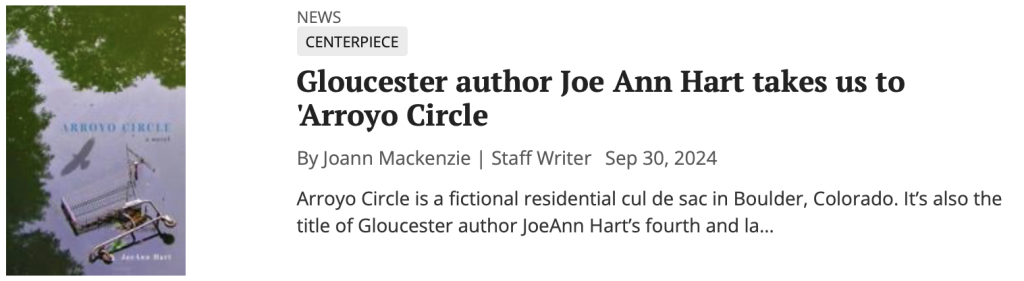
- By Joann Mackenzie | Staff Writer, Gloucester Times, Sep 30, 2024
Arroyo Circle is a fictional residential cul de sac in Boulder, Colorado. It’s also the title of Gloucester author JoeAnn Hart’s fourth and latest book.
What Hart, an award-winning environmental writer, has created in Arroyo Circle is a metaphor for 21st-century America, a beautiful place inhabited by humans who seem intent on destroying it through progress, aka profit.
Here, the achievements of two centuries of industrial and technological ‘progress’ driven by fossil fuels has come home to roost, wreaking havoc on a cast of characters who are as familiar as neighbors in any small American town.
Climate change — a topic Hart has explored in short stories, essays, and a novel — is central to the problems of Arroyo Circle, but Hart does not stop there. In Arroyo Circle, we get the full catastrophe of where the 21st century has taken America: a place threatened by epic consumerism, waste, and fatal carelessness. homelessness, and a culture of power and violence.
Hart wastes no time as we quickly find ourselves in a supermarket parking lot jam-packed with fossil-fuel-driven cars and their owners steering fully loaded shopping carts.
Here we meet Shelley, a fraught American uber-consumer hurriedly loading her latest bargain — a giant bag of cat litter — into the trunk of her car. Shelley has other things on her mind, a lot of other things, including the suffocating heat, whirling helicopters, and smoke drifting in from wildfires.
Unbeknownst to Shelley, she is being watched. By someone who mistakes her giant bag of cat litter for a baby and Shelley for a kidnapper. This someone calls 911 and upon arrival home, Shelley is met by the kind of SWAT team that inhabits American TV screens daily.
And we are off to the stuff that page-turners are made of, as Shelley, cleared of kidnapping, takes us into the world of Arroyo Circle and the home of Mimi, a wealthy pampered woman who has long since arrived at end-stage consumerism, aka hoarding. Shelley works for Mimi and Mimi’s enabling husband, ostensibly as a house manager, but in reality more as Mimi’s supplier, filling Mimi’s house with stuff.
We quickly get the picture that picture-perfect ‘Arroyo Circle’ is far from perfect. In time, it will live up to its name, which from Spanish translates as “a dry creek, stream bed or gulch that temporarily or seasonally fills and flows after sufficient rain. Flash floods are common in arroyos following thunderstorms.”
Like the Earth itself, Arroyo Circle is vulnerable, in need of tender loving care, and nobody in Arroyo Circle gets that better than Les. Les says his “address is the world.” In fact, he lives down the gully by the creek, where homeless people have established one of those tent cities that have become part of the American landscape.
Les is one of those homeless people who make you rethink the meaning of the phrase, “The meek shall inherit the Earth.” The Earth is Les’s home. He literally sleeps on the earth and swears it is contoured by nature to comfortably accommodate a sleeping human.
Les may seem to the locals like someone from another planet, a nuisance to be shooed off the streets by the cops, but like Henry David Thoreau, he cautions his fellow humans ‘to resign themselves to the influence of the Earth.’
Les is an outsider, removed from the game of life, the better to understand the big picture, and see the big picture in the smallest of nature’s creations. In the flight of a bird, the petals of a flower. He is at one and at peace with the Earth, and when Hart writes about him or in his person, her words sing.
This may be because Hart based Les on her beloved brother, Tommy. A homeless alcoholic like Les, when Tommy died seven years ago Hart started writing what would become Arroyo Circle, a cautionary tale that reminds us that whether we live in a mansion or a humble cottage, like Les — like Tommy — Earth is our home.